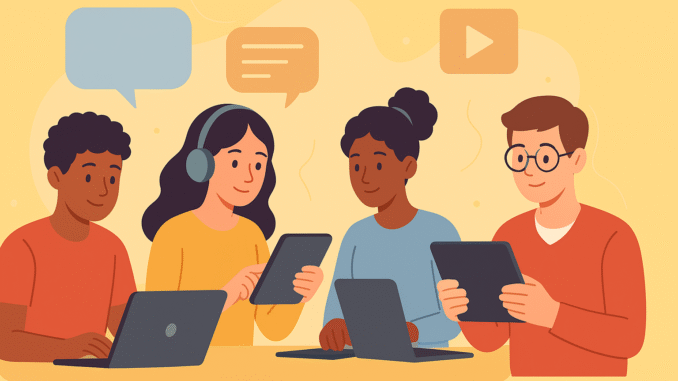
How Digital Learning Is Shaping the Future of Education for Students Worldwide
In recent years, education has undergone a dramatic transformation driven by rapid technological advancements. Digital learning, once an alternative method of instruction, has now become a global standard shaping how students learn, communicate, and engage with knowledge.
From interactive classrooms and AI tutors to online universities and gamified courses, digital learning is redefining the traditional boundaries of education. As we move further into the digital age, it’s clear that this shift is not temporary—it’s the future of education.
Let’s explore how digital learning is transforming the educational landscape for students worldwide and what it means for the future of learning.
1. The Global Shift Toward Digital Learning
The rise of digital learning has been accelerated by accessibility, technology innovation, and necessity. The COVID-19 pandemic in the early 2020s was a major catalyst that forced schools and universities to adopt online learning tools. However, what started as a temporary solution quickly evolved into a long-term educational model.
Today, over 1.5 billion students globally have access to some form of digital education. Governments and institutions are investing heavily in e-learning infrastructure to ensure that education is inclusive and sustainable. Platforms like Google Classroom, Coursera, and Microsoft Teams for Education are now integral to teaching systems worldwide.
This transformation has democratized education, making it possible for anyone with an internet connection to access quality learning, regardless of their location or financial background.
SEO Keywords: digital learning, global education, online education trends
2. Breaking Barriers Through Accessibility
One of the most significant impacts of digital learning is its ability to make education more accessible.
In the past, geographical and financial constraints limited access to quality education. Students in remote or underdeveloped regions often lacked trained teachers or educational resources. Digital platforms now bridge that gap.
With open online courses (MOOCs) from top universities, students from any part of the world can learn subjects ranging from computer science to art history for free or at a low cost.
Additionally, mobile learning (m-learning) enables students to access lessons via smartphones, ensuring education is available anytime, anywhere. This flexibility empowers working professionals, parents, and lifelong learners to study at their own pace.
SEO Keywords: accessible education, e-learning platforms, mobile learning
3. Personalized and Adaptive Learning Experiences
Traditional education often followed a one-size-fits-all approach, where every student was expected to learn at the same pace. Digital learning changes that.
With the help of Artificial Intelligence (AI) and machine learning, educational platforms can now analyze a student’s strengths, weaknesses, and learning habits to create a personalized learning path.
For example, if a student struggles with algebra but excels in geometry, AI systems can recommend specific tutorials, exercises, and assessments that target those weaker areas.
This adaptive approach ensures that each learner receives an education tailored to their needs, increasing engagement and improving outcomes.
SEO Keywords: personalized learning, AI in education, adaptive learning systems
4. Interactive and Engaging Learning Environments
One of the reasons digital learning has gained immense popularity is its interactivity. Gone are the days of static textbooks and monotonous lectures. Today, students learn through videos, simulations, gamified quizzes, and virtual labs.
For instance, science students can perform virtual chemistry experiments, and history students can explore 3D models of ancient civilizations. These experiences make learning immersive and fun.
Gamification—using game-like elements such as badges, leaderboards, and progress tracking—motivates students to participate actively and stay committed to their studies.
This dynamic learning style not only enhances retention but also nurtures creativity and problem-solving skills.
SEO Keywords: interactive learning, gamified education, virtual classrooms
5. The Rise of Hybrid and Blended Learning Models
In 2025 and beyond, education is no longer confined to physical classrooms. Instead, a hybrid learning model—combining online and in-person instruction—has emerged as the new norm.
This flexible approach allows students to enjoy the best of both worlds: the social experience of in-person classes and the convenience of digital resources.
Teachers use video conferencing tools, discussion forums, and collaborative online spaces to keep students connected. Assignments, tests, and projects are managed digitally, reducing paperwork and improving efficiency.
Hybrid education promotes inclusivity, ensuring that even students who cannot attend physical classes due to health, distance, or financial issues can still learn effectively.
SEO Keywords: hybrid learning, blended classrooms, digital education systems
6. Virtual Reality (VR) and Augmented Reality (AR) in Learning
The integration of Virtual Reality (VR) and Augmented Reality (AR) has taken digital learning to a new dimension. These technologies create immersive experiences that make abstract concepts tangible and easier to understand.
For instance, medical students can practice surgery in a simulated VR environment, and geography students can virtually visit different continents.
AR overlays digital content onto real-world settings—like showing a 3D solar system on a tablet screen. This combination of visual and hands-on experience enhances comprehension and engagement.
These innovations have proven especially effective in STEM (Science, Technology, Engineering, and Mathematics) education, where visualization is key.
SEO Keywords: virtual reality in education, augmented reality learning, immersive education
7. Collaborative Learning Across Borders
Digital learning has turned education into a global community. Students can now collaborate with peers from different countries through virtual classrooms, group projects, and online discussions.
Platforms like Zoom, Slack, and Notion facilitate real-time teamwork and communication. This global connectivity helps students develop cross-cultural understanding, teamwork, and communication skills—all essential for success in a connected world.
Moreover, exposure to diverse perspectives encourages creativity and critical thinking, preparing learners for international careers.
SEO Keywords: global collaboration, online group learning, international education
8. Empowering Teachers with Digital Tools
While digital learning benefits students, it also empowers teachers. Educators now have access to data analytics, AI-powered grading systems, and learning management systems (LMS) that simplify administrative tasks and allow more time for teaching.
Teachers can track student progress, identify learning gaps, and provide targeted feedback instantly. They also use multimedia tools—videos, infographics, and podcasts—to make lessons more engaging.
Professional development opportunities through online workshops and webinars help teachers stay updated with the latest teaching strategies and technologies.
SEO Keywords: teacher technology tools, LMS platforms, digital teaching innovation
9. The Role of AI Tutors and Chatbots
Artificial Intelligence has brought the concept of AI tutors and chatbots to life. These digital assistants can answer student questions, provide explanations, and guide them through exercises 24/7.
For example, language learning apps like Duolingo use AI to offer personalized feedback and conversational practice. Similarly, AI bots integrated into online platforms provide instant responses and reduce the dependency on classroom time.
This constant availability ensures that learning never stops, helping students remain curious and independent learners.
SEO Keywords: AI tutors, chatbots in education, intelligent learning assistants
10. Preparing Students for the Future Workforce
Digital learning isn’t just about delivering knowledge—it’s about preparing students for the digital economy. The modern workforce demands skills such as digital literacy, critical thinking, collaboration, and problem-solving.
Online platforms now offer courses on coding, data analysis, artificial intelligence, and entrepreneurship. Students learn to use digital tools that are relevant in the real world, giving them a competitive advantage in their future careers.
Additionally, remote learning teaches self-discipline, time management, and adaptability—skills highly valued by employers in the global job market.
SEO Keywords: future of work, digital skills, workforce education
The Challenges Ahead
Despite its many benefits, digital learning still faces challenges. Limited internet access in rural areas, lack of digital literacy, and insufficient training for teachers remain significant barriers.
There are also concerns about screen fatigue and the need for maintaining human interaction in learning. To overcome these, policymakers and educators must focus on creating balanced, inclusive, and human-centered digital learning ecosystems.
As technology continues to evolve, addressing these challenges will be key to ensuring that digital education benefits everyone equally.
SEO Keywords: challenges of online education, education equity, digital divide
The Future of Digital Education
The future of education is digital, flexible, and lifelong. As technologies like AI, VR, and cloud computing continue to advance, learning will become more personalized, engaging, and accessible than ever before.
Digital learning is not replacing traditional education—it’s enhancing it. The combination of technology and human creativity is building a smarter, more connected global learning community.
Students today aren’t just consuming information—they’re creating it, sharing it, and shaping the future of knowledge.