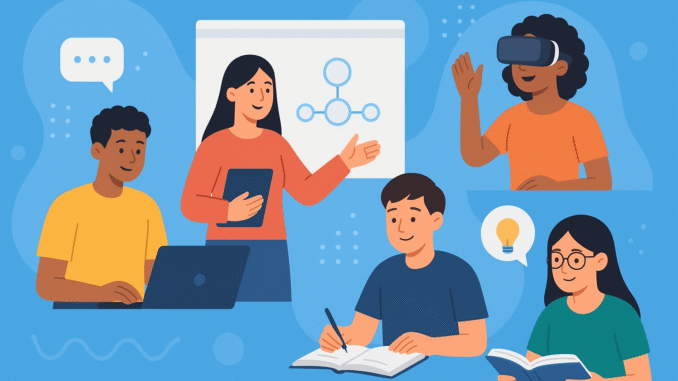
Top 10 Innovative Teaching Methods Transforming Modern Education in 2025
Education has always been the foundation of human progress, but the way we teach and learn has undergone a remarkable transformation in recent years. In 2025, classrooms look drastically different from those of the past decade. From artificial intelligence and gamified learning to experiential education and virtual classrooms, new methods are redefining how teachers engage students and how learners absorb knowledge.
Below are the top 10 innovative teaching methods revolutionizing modern education in 2025.
1. Artificial Intelligence (AI)-Powered Personalized Learning
AI has become one of the most influential forces in modern education. Teachers are now leveraging AI tools to personalize learning experiences for each student based on their strengths, weaknesses, and learning pace.
AI algorithms analyze student performance and recommend tailored lessons, exercises, and quizzes. Platforms like ChatGPT Edu, Khanmigo, and Squirrel AI help educators track progress and adjust teaching strategies in real time.
This personalized approach ensures that every learner—whether advanced or struggling—receives the attention and support they need to thrive. It’s a step away from the one-size-fits-all model and toward a more student-centered learning environment.
SEO Keywords: AI in education, personalized learning, adaptive learning systems
2. Gamification of Learning
Gamification continues to dominate education in 2025. This approach integrates game design elements—such as point systems, leaderboards, badges, and rewards—into traditional learning activities.
Students now engage in math adventures, science quests, and historical simulations that make learning more interactive and enjoyable. Gamified learning boosts motivation, improves memory retention, and encourages healthy competition among students.
Teachers use platforms like Classcraft, Kahoot!, and Quizizz to gamify lessons both in-person and online. The key is that learning feels less like an obligation and more like an exciting challenge.
SEO Keywords: gamified learning, education technology, interactive classroom
3. Virtual Reality (VR) and Augmented Reality (AR) Learning
The integration of VR and AR has turned classrooms into immersive environments where students can explore the world beyond textbooks.
Imagine studying ancient Egypt by virtually walking through the pyramids or learning human anatomy by interacting with a 3D model of the human body. VR headsets and AR-enabled devices allow students to experience concepts instead of just reading about them.
This sensory-rich approach enhances understanding and keeps students deeply engaged. Moreover, it bridges the gap between theory and practice—especially in fields like science, architecture, and medicine.
SEO Keywords: virtual reality in education, AR classroom, immersive learning
4. Flipped Classroom Model
The flipped classroom concept has evolved significantly by 2025. In this model, students watch pre-recorded lectures or online materials at home, while class time is dedicated to discussions, projects, and problem-solving.
This approach shifts the teacher’s role from a lecturer to a facilitator. It encourages active learning and ensures that students come prepared to engage in meaningful discussions.
With tools like YouTube, Google Classroom, and Edpuzzle, educators easily create engaging video lessons, enabling students to learn at their own pace and revisit difficult concepts when needed.
SEO Keywords: flipped classroom, blended learning, student engagement
5. Project-Based Learning (PBL)
Project-Based Learning (PBL) has become a cornerstone of modern education, emphasizing real-world applications of academic concepts. Instead of memorizing facts, students work on projects that solve real-life problems—such as designing sustainable cities or developing eco-friendly products.
PBL encourages critical thinking, creativity, teamwork, and communication. It mirrors the collaborative nature of the modern workplace, helping students develop practical skills that go beyond exams and textbooks.
Schools and universities now partner with industries and communities to make projects more impactful and relevant.
SEO Keywords: project-based learning, experiential education, real-world learning
6. Hybrid and Online Learning Models
The COVID-19 pandemic reshaped the global education system, and by 2025, hybrid learning—a mix of online and in-person education—has become standard practice.
Students can now choose flexible learning schedules that accommodate different lifestyles and learning preferences. Teachers use platforms like Zoom, Microsoft Teams, and Google Meet for live sessions, while Learning Management Systems (LMS) like Canvas or Moodle help organize coursework.
This flexibility allows learners from different geographic regions and backgrounds to access quality education without barriers.
SEO Keywords: hybrid learning, online education, digital classrooms
7. Inquiry-Based Learning
Inquiry-based learning focuses on curiosity, exploration, and discovery. Instead of passively receiving information, students ask questions, investigate, and construct their own understanding of a topic.
Teachers guide rather than instruct, fostering analytical and problem-solving skills. For instance, in a science class, students might be asked to investigate “What causes climate change?” rather than being given a predefined answer.
This student-driven approach promotes critical thinking and a lifelong passion for learning—skills essential in a rapidly changing world.
SEO Keywords: inquiry-based learning, critical thinking, active learning strategies
8. Social and Emotional Learning (SEL)
In 2025, education isn’t just about academics—it’s also about nurturing emotional intelligence. Social and Emotional Learning (SEL) focuses on helping students develop empathy, self-awareness, and interpersonal skills.
Teachers incorporate mindfulness exercises, group reflections, and emotional check-ins into daily routines. Research shows that students with strong emotional skills perform better academically and exhibit improved behavior and resilience.
SEL programs are now embedded into curricula worldwide, ensuring students grow into emotionally intelligent and socially responsible individuals.
SEO Keywords: social emotional learning, emotional intelligence in education, SEL programs
9. Experiential and Outdoor Learning
As education moves beyond the classroom, experiential learning—learning through direct experience—has gained tremendous popularity.
Field trips, outdoor science experiments, community service projects, and cultural immersions allow students to apply theoretical knowledge in real-world contexts. Outdoor learning, in particular, fosters environmental awareness and appreciation for nature.
This hands-on method enhances memory retention and helps students connect deeply with the world around them, fostering a sense of purpose and responsibility.
SEO Keywords: experiential learning, outdoor education, hands-on learning
10. Collaborative and Peer-to-Peer Learning
Finally, collaborative learning has become a defining feature of education in 2025. Students work in teams to solve problems, discuss concepts, and share ideas. Peer-to-peer learning fosters communication, cooperation, and leadership skills.
Digital platforms like Slack, Notion, and Miro make teamwork seamless—even in virtual settings. Teachers act as facilitators, guiding discussions and ensuring every student contributes meaningfully.
This method reflects real-world professional environments, preparing students to succeed in team-oriented workplaces.
SEO Keywords: collaborative learning, peer-to-peer education, teamwork in classroom
The Future of Education: A Blended, Tech-Driven Ecosystem
The teaching methods shaping education in 2025 highlight one major theme: adaptability. Technology continues to enhance, not replace, the human touch in education. Teachers remain central figures—mentors, guides, and motivators—but their roles have evolved to align with a more digital, flexible, and student-centered world.
As AI, VR, and global connectivity expand, the future of learning will become even more interactive, personalized, and inclusive. The ultimate goal isn’t just to teach facts—but to empower students with the skills, creativity, and mindset needed to navigate the challenges of tomorrow.
Education in 2025 isn’t confined to classrooms—it’s a lifelong journey powered by innovation.