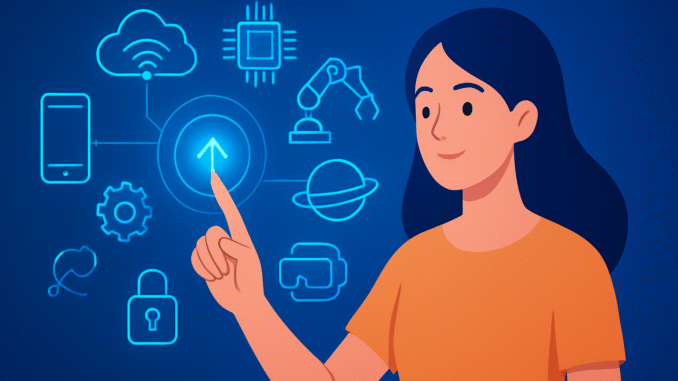
Top 10 Emerging Technologies Transforming the Future in 2025
Technology continues to evolve at lightning speed, reshaping how we live, work, and interact with the world. As we move deeper into 2025, innovation shows no signs of slowing down. From artificial intelligence and quantum computing to biotechnology and sustainable energy, emerging technologies are redefining industries and creating new opportunities for growth.
In this article, we’ll explore the top 10 emerging technologies transforming the future in 2025, their real-world applications, and how they are shaping tomorrow’s digital landscape.
1. Artificial Intelligence (AI) and Machine Learning (ML)
Artificial Intelligence (AI) remains at the forefront of technological innovation in 2025. AI has evolved from simple automation tools to intelligent systems capable of reasoning, decision-making, and creative problem-solving.
Machine Learning (ML), a subset of AI, enables computers to learn from data and improve over time without human intervention. In 2025, AI and ML are being used in nearly every sector—healthcare, finance, education, and transportation—to increase efficiency and accuracy.
Applications of AI and ML in 2025:
- Healthcare: AI-powered diagnostic tools are helping doctors detect diseases earlier and more accurately.
- Customer Service: Chatbots and virtual assistants now offer human-like conversations.
- Finance: Algorithms predict market trends and detect fraudulent activities.
- Education: Personalized learning platforms adapt to each student’s needs.
AI is also playing a key role in sustainability, optimizing energy use and reducing waste in manufacturing and logistics.
2. Quantum Computing
Quantum computing is no longer just a futuristic concept—it’s rapidly becoming a practical tool for solving complex problems beyond the reach of classical computers.
In 2025, tech giants like IBM, Google, and startups around the world are racing to build stable quantum systems that can perform calculations millions of times faster than traditional processors.
Impact of Quantum Computing:
- Drug Discovery: Accelerates the simulation of molecular interactions for new medicines.
- Cryptography: Redefines data security with quantum encryption methods.
- Optimization Problems: Enhances logistics, supply chains, and financial modeling.
Quantum computing holds the promise of transforming industries by unlocking computing power we once thought impossible.
3. Extended Reality (XR) – VR, AR, and MR
Extended Reality (XR) — which combines Virtual Reality (VR), Augmented Reality (AR), and Mixed Reality (MR) — is reshaping entertainment, education, and even workplace training.
In 2025, XR technologies are more immersive, realistic, and accessible than ever before. With the help of 5G and improved hardware, users can interact with digital environments in ways that feel seamless and lifelike.
Real-World Uses of XR:
- Education: Virtual classrooms offer interactive, hands-on experiences.
- Healthcare: Surgeons use AR-guided systems for precision operations.
- Retail: Customers try products virtually before buying.
- Corporate Training: Simulated environments prepare employees for real-world challenges.
XR is closing the gap between the physical and digital worlds, changing how people experience content and connect with others.
4. 5G and Next-Gen Connectivity
The global rollout of 5G technology has revolutionized communication and connectivity. By 2025, most developed regions are powered by ultra-fast 5G networks, enabling data transmission speeds up to 100 times faster than 4G.
This next-generation connectivity forms the backbone of other emerging technologies such as autonomous vehicles, smart cities, and the Internet of Things (IoT).
Benefits of 5G:
- Low latency for real-time communication
- Faster data transfer for streaming and gaming
- Enhanced IoT network capacity
- Better support for smart devices and automation
With 6G already in early development, the future of connectivity looks even more promising.
5. Internet of Things (IoT) and Smart Ecosystems
The Internet of Things (IoT) continues to expand, connecting billions of devices around the globe. In 2025, IoT goes beyond smart homes — it’s driving smart cities, smart agriculture, and intelligent industries.
IoT devices collect and analyze real-time data to improve decision-making, enhance productivity, and reduce energy consumption.
Key Applications:
- Smart Homes: Appliances and systems adjust automatically for convenience and efficiency.
- Smart Cities: Traffic management and energy systems reduce congestion and pollution.
- Healthcare: Wearable devices track vital signs and monitor patient health remotely.
IoT’s integration with AI and 5G is building a connected world that’s more efficient and sustainable than ever before.
6. Blockchain and Web 3.0 Technologies
While blockchain is best known for powering cryptocurrencies, in 2025 it has evolved into a foundational technology for Web 3.0, the next era of the internet focused on decentralization, transparency, and user control.
Blockchain’s ability to create secure, tamper-proof digital records has made it invaluable in finance, supply chains, and digital identity management.
Emerging Blockchain Uses:
- Decentralized Finance (DeFi): Enables secure, peer-to-peer financial transactions.
- NFTs and Digital Ownership: Authenticates ownership of digital assets.
- Smart Contracts: Automate business agreements without intermediaries.
- Supply Chain Transparency: Tracks goods from production to delivery.
Web 3.0 technologies are shaping a more democratic digital ecosystem where users have greater ownership of their data and digital lives.
7. Biotechnology and Genetic Engineering
Advances in biotechnology are transforming healthcare, agriculture, and environmental conservation. In 2025, gene editing technologies like CRISPR are being used to cure genetic disorders, improve crop resilience, and even combat climate change.
Major Breakthroughs:
- Personalized Medicine: Tailored treatments based on individual genetic profiles.
- Sustainable Agriculture: Genetically modified crops resistant to pests and extreme climates.
- Biomanufacturing: Produces sustainable materials, fuels, and food alternatives.
Biotechnology holds the potential to solve some of humanity’s most pressing challenges, from food security to disease prevention.
8. Renewable Energy and Green Tech
The shift toward sustainable energy is accelerating, driven by innovations in solar, wind, and battery storage technologies. In 2025, green technology is not only an environmental goal but also a major economic driver.
New breakthroughs in hydrogen power, carbon capture, and recycling technologies are helping reduce global emissions and dependence on fossil fuels.
Key Trends:
- Solar and Wind: Cheaper and more efficient power generation.
- Energy Storage: Advanced batteries store renewable energy for longer durations.
- Smart Grids: AI-powered grids optimize energy distribution and reduce waste.
These innovations are paving the way for a carbon-neutral future.
9. Autonomous Vehicles and Advanced Robotics
Autonomous technology is advancing rapidly, with self-driving cars, drones, and robots becoming more intelligent and reliable. In 2025, autonomous systems are transforming industries from logistics to healthcare.
Examples:
- Self-Driving Cars: Major companies are launching fully autonomous fleets for urban transport.
- Delivery Drones: Accelerate last-mile delivery and reduce logistics costs.
- Robotic Automation: Improves precision and productivity in manufacturing and surgery.
Robots are also entering daily life, assisting the elderly, providing companionship, and performing household tasks.
10. Cybersecurity and Privacy Enhancements
As technology evolves, so do digital threats. In 2025, cybersecurity is more critical than ever. With more data stored online, advanced security solutions using AI, blockchain, and quantum encryption are emerging to protect individuals and organizations.
Top Trends in Cybersecurity:
- AI-Powered Threat Detection: Identifies and neutralizes attacks in real time.
- Zero-Trust Architecture: Ensures every user and device is verified.
- Quantum Encryption: Provides virtually unbreakable data protection.
Enhanced privacy tools also empower users to control their personal data in the digital era.
Conclusion
The technologies shaping 2025 are more than just innovations—they’re revolutionizing the way we live and interact with the world. From AI and quantum computing to biotechnology and green energy, these emerging technologies are laying the foundation for a smarter, more connected, and sustainable future.
Businesses, governments, and individuals who embrace these advancements will not only stay ahead of the curve but also help shape a better world for generations to come.